K. Suryanrayanan, A.B. Croll, and H. Singh
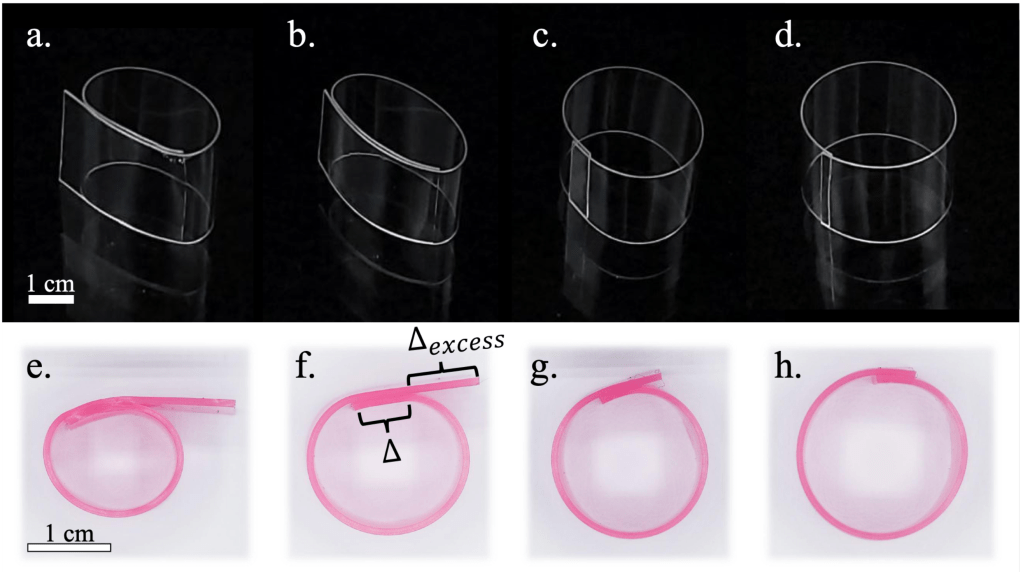
We present an experimental and theoretical study of the mechanics of an adhesive tape loop, formed by bending a straight rectangular strip with adhesive properties, and prescribing an overlap between the two ends. For a given combination of the adhesive strength and the extent of the overlap, the loop may unravel, it may stay in equilibrium, or open up quasi-statically to settle into an equilibrium with a smaller overlap. We define the state space of an adhesive tape loop with two parameters: a non-dimensional adhesion strength, and the extent of overlap normalized by the total length of the loop. We conduct experiments with adhesive tape loops fabricated out of sheets of polydimethylsiloxane (PDMS) and record their states. We rationalize the experimental observations using a simple scaling argument, followed by a detailed theoretical model based on Kirchhoff rod theory. The predictions made by the theoretical model, namely the shape of the loops the states corresponding to equilibrium, show good agreement with the experimental data. Our model may potentially be used to deduce the strength of self-adhesion in sticky soft materials by simply measuring the smallest overlap needed to maintain a tape loop in equilibrium.

 Geometry and Mechanics of Solids